
This is Post 6 in our hail damage series for Hinsdale, Downers Grove, Clarendon Hills, Darien, Burr Ridge, La Grange, Hodgkins, Willowbrook, Oak Brook, and Brookfield drivers. [Missed Post 5? See how collision centers and PDR shops compare.]
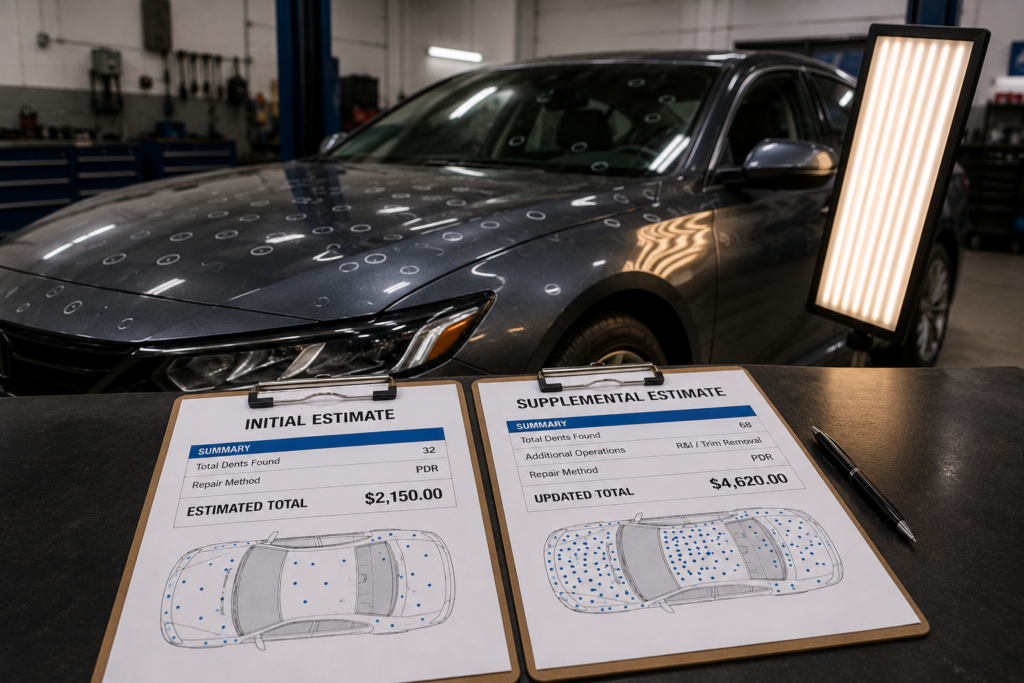
If your first hail damage estimate came in lower than you expected, you’re not imagining things — and you’re not alone. Low initial estimates are common enough in the hail claims process that it’s worth understanding exactly why they happen, so you know how to respond instead of just accepting the number you’re given.
Insurers Have to Pay Covered Claims — But They Also Manage Costs
Here’s the balance worth understanding: if you carry full coverage, your insurer is contractually obligated to pay for covered hail damage. That’s not in question. At the same time, insurance companies — like any business — have a financial incentive to manage how much they pay out on claims. That incentive doesn’t make every estimate dishonest, but it does help explain why the starting point of an estimate tends to land on the conservative side rather than the generous one.
Where the Gap Actually Comes From
Inspection conditions. As we covered in Post 2, home and driveway inspections often rely on daylight rather than dedicated PDR lighting. Under normal daylight, many hail dents simply don’t cast the shadows needed to see them — which means an initial dent count can come in low not because anyone is trying to shortchange you, but because the inspection method itself isn’t built to catch everything.
Conservative dent counts. Even under good lighting, smaller or shallower dents are easy to undercount on a first pass, especially during high-volume periods right after a major storm when adjusters are moving quickly through a large backlog of claims.
Missing line items. Initial estimates frequently leave out things like R&I (remove-and-reinstall) operations, molding removal, or hidden dents near trim and roof rails — all of which are often only identified once a shop does a full, hands-on evaluation.
Pressure to close claims quickly. After a major hailstorm, insurers are processing a high volume of claims in a short window. Speed can come at the expense of thoroughness, which tends to push initial numbers toward the low end.
Why This Matters for You
None of this means you have to accept the first number. It means the first number is often a starting point, not a final answer — and knowing that changes how you approach the process. A supplement (an updated, corrected estimate submitted after a more thorough inspection) isn’t a special favor from your shop — it’s the normal mechanism for correcting a low initial estimate with real documentation.
How to Push Back Effectively
- Get a second inspection under proper PDR lighting before accepting the first number as final.
- Ask for the estimate broken down line by line — a vague total is harder to challenge than an itemized one.
- Have your shop document everything — photos, dent counts, and specific line items — to support a supplemental estimate.
- Don’t assume a low estimate is your only option. You’re entitled to request a more thorough evaluation, and insurers are used to receiving supplements — it’s a routine part of the process, not a confrontation.
Coming Up Next in This Series
In our next post, we’ll cover another claim outcome that raises a lot of questions: what it actually means when your insurer offers to total your vehicle — including what Actual Cash Value (ACV) is and why it matters.
About What The Hail Auto Dent Repair
What The Hail Auto Dent Repair, located at 2325 Wisconsin Ave, Downers Grove, IL, documents every hail repair thoroughly from the start — giving you the paperwork you need to push back on a low estimate with confidence.
Contact us today to schedule your hail damage assessment.