
This is Post 4 in our hail damage series for Hinsdale, Downers Grove, Clarendon Hills, Darien, Burr Ridge, La Grange, Hodgkins, Willowbrook, Oak Brook, and Brookfield drivers. [Missed Post 3? Read about your right to choose your own repair shop.]
By now you know that being on your insurer’s preferred list doesn’t mean you’re required to use that shop. But there’s a related assumption worth unpacking too: the idea that a “preferred” or “in-network” shop is automatically the better choice for hail damage specifically. That’s not always the case — and understanding why can save you from a repair that doesn’t hold up the way you’d expect.
What “Preferred” Actually Measures
Being added to an insurer’s preferred vendor list typically reflects things like processing speed, paperwork efficiency, and volume agreements — not necessarily specialization in a specific type of repair. A shop can be an excellent choice for general collision work (accidents, fender benders, bumper replacements) while having very little day-to-day experience with hail damage specifically.
That distinction matters more than most drivers realize.
The Outsourcing Reality
Here’s something that surprises a lot of people: many collision centers, dealerships, and general body shops don’t have an in-house PDR technician. When hail damage claims come in, they often bring in outside PDR contractors to handle that portion of the work.
This isn’t inherently a problem — but after a major hailstorm, demand for PDR technicians spikes fast. Shops that don’t normally handle hail volume sometimes bring on technicians they haven’t worked with before, simply to keep up. Without an established relationship or a track record with that technician, it’s hard for the shop itself to guarantee the quality of that specific repair.
Why Experience Level Varies So Much in PDR
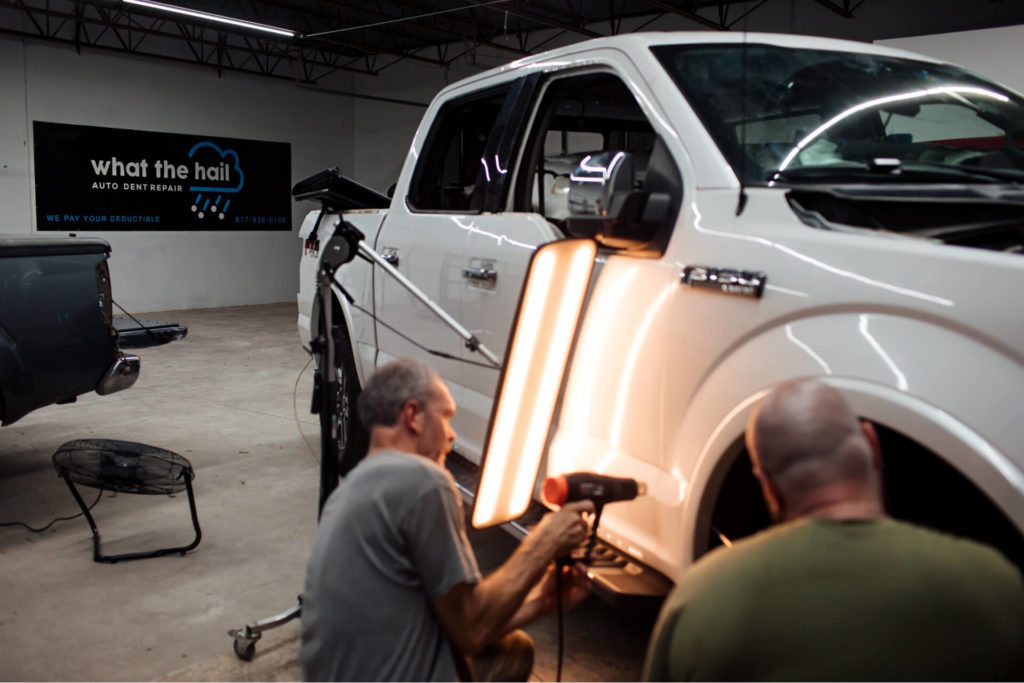
Paintless Dent Repair is a skill that improves significantly with repetition. A technician who works hail damage daily develops a trained eye for depth, panel behavior, and where metal can be safely pushed back without stressing the paint. A technician with limited experience — even a capable one — is more likely to miss smaller dents or take a slower, less precise approach.
This is why it’s worth asking directly:
- “Who will actually be performing the PDR work on my vehicle?”
- “Is this technician in-house, or outsourced for this repair?”
- “How many years of specific PDR experience do they have?”
A shop confident in its process should have no problem answering these clearly.
Quality Control Is Also Part of the Equation
Beyond individual skill, it’s worth considering how a shop verifies its own work. Daily-PDR shops typically have internal quality checks built into their process — multiple-angle lighting reviews, panel-by-panel sign-off — because hail repair is the core of what they do, not an occasional add-on. That kind of built-in accountability is harder to maintain for a shop where hail repair is a small fraction of overall volume.
What This Means for You
None of this means preferred or general collision shops are bad — many do excellent work in their core specialty. It simply means “preferred” and “specialized in hail damage” are two different things, and it’s worth confirming which one you’re actually getting before you commit.
Coming Up Next in This Series
In our next post, we’ll put this side by side directly: Collision Center vs. PDR Shop — Which One Protects Your Car’s Value? — including what each repair path can mean for your Carfax report down the road.
About What The Hail Auto Dent Repair
What The Hail Auto Dent Repair, located at 2325 Wisconsin Ave, Downers Grove 60515, IL, focuses exclusively on Paintless Dent Repair. Our technicians bring a minimum of six years of proven, in-house PDR experience to every repair — no outsourcing, no guesswork.
Contact us today to schedule your hail damage assessment.